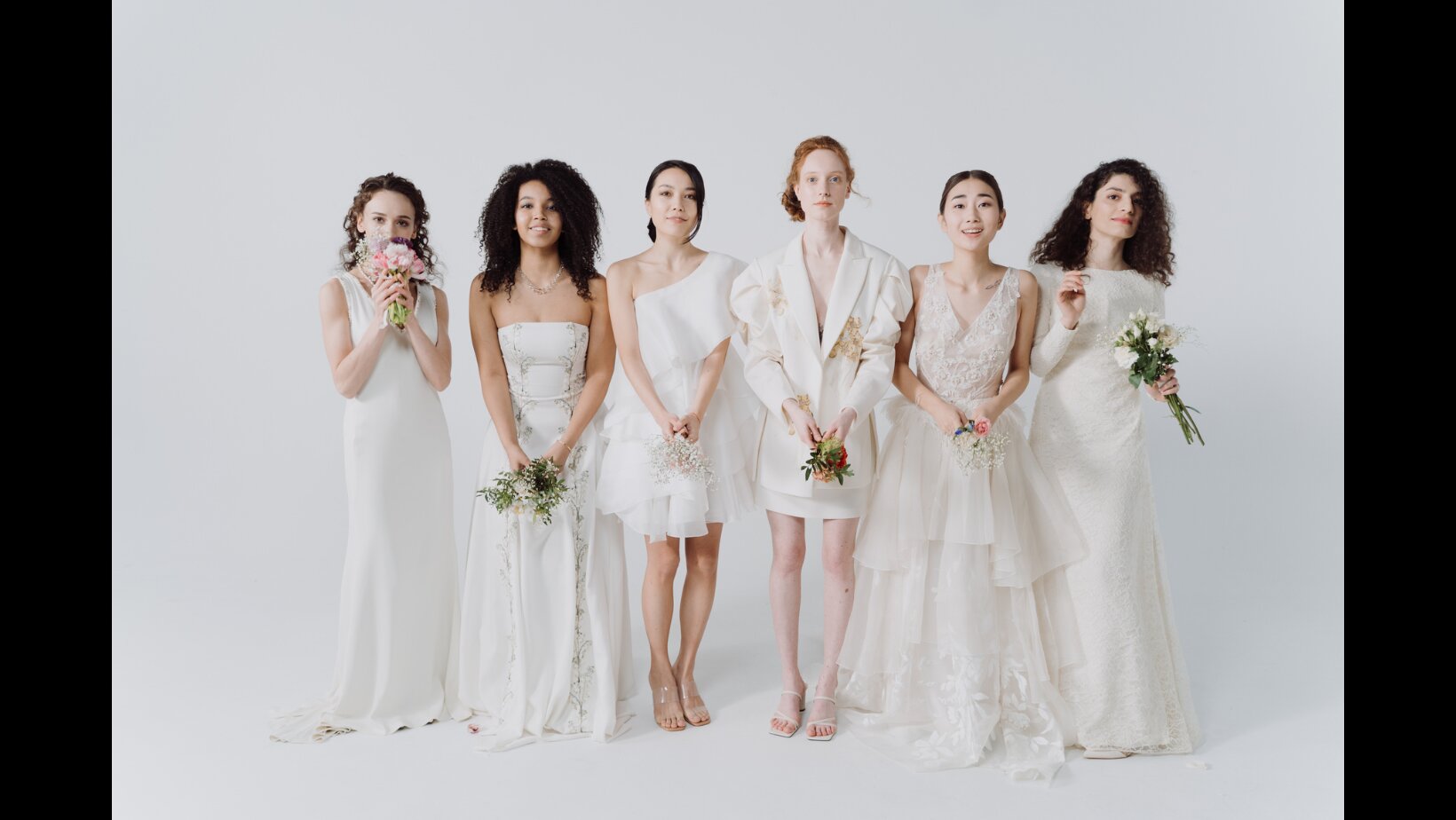
Dear future bride, your moment has arrived too: the choice of the dress! It is a very important decision and should be made with awareness, to be sure that on that day you will feel at ease and perfect within the overall context. For some it may not be very easy, others may have what is called love at first sight; to make your task easier, I present to you the guide that every future bride would like to have! Tips and suggestions on how to choose the right wedding dress for you and for the style of your wedding.
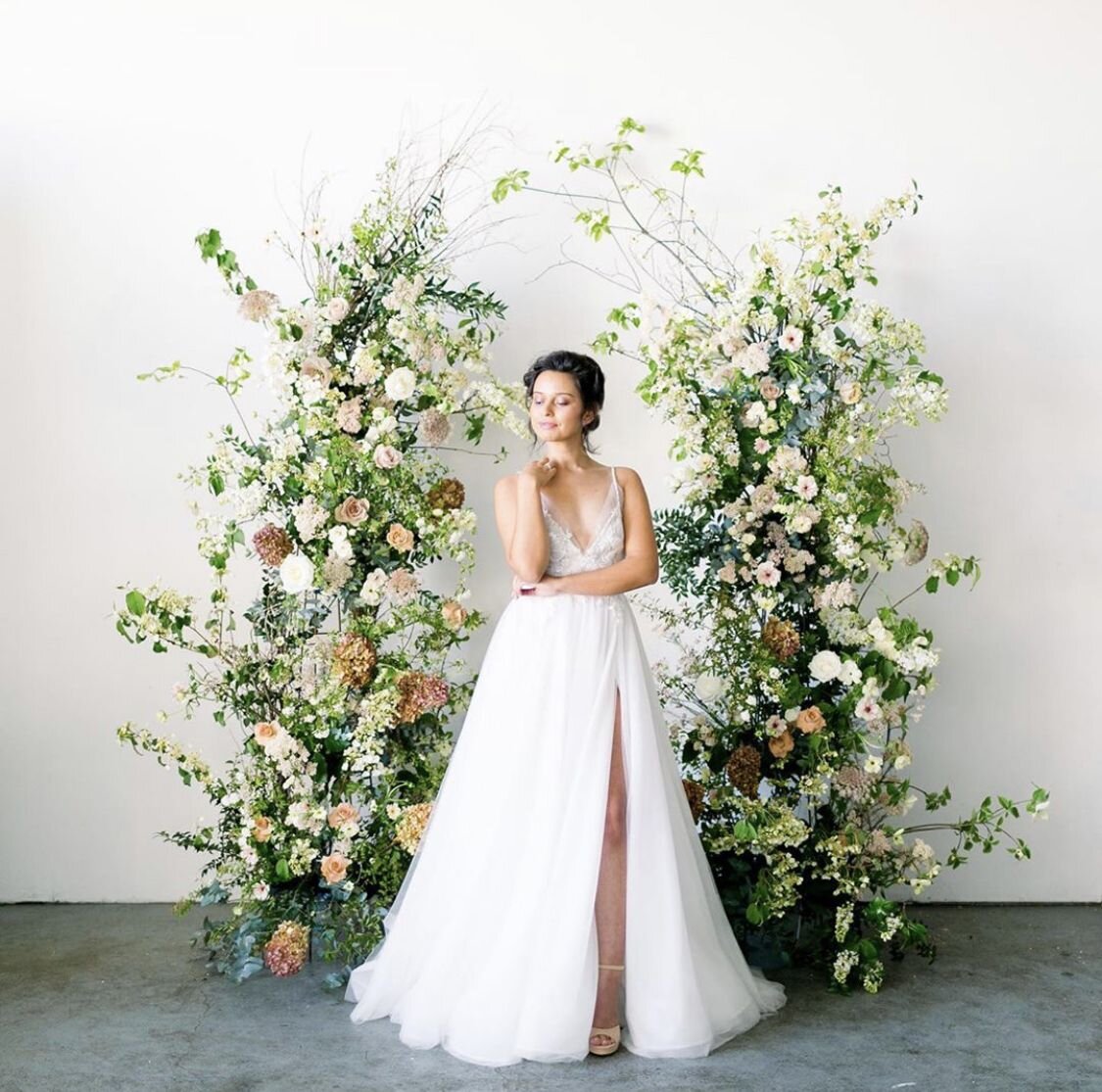
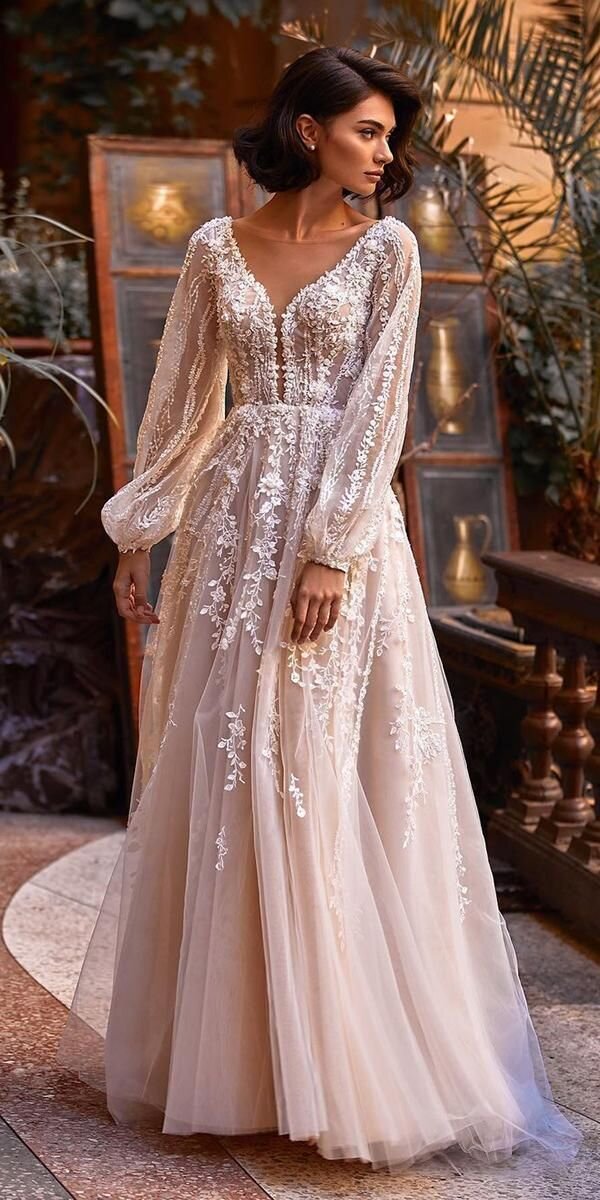
Step 1: Choose a dress that is “yours” The wedding dress, in addition to the silhouette, must also suit the personality of every woman! Very often, when you arrive at the atelier, you are pleasantly surprised by the fact that a dress you thought was completely wrong for you actually fits your features perfectly. The dress must in fact best represent your personality and your character without necessarily overdoing it. Look for a dress with details and features that make you feel unique and special, but that do not weigh down your figure or make you feel uncomfortable or uneasy for the entire day. Ask yourself the question: does this dress represent me as a person? Your wedding day is not the right occasion to overturn your personality. If you are a shy person, avoid excessive necklines or overly dramatic dresses, don’t go for heavy makeup or a very showy hairstyle. If you are a classic bride you might opt for an elegant, refined, and timeless dress, with a V-neckline or a bateau neckline, embellished with jewelry and a veil. Romantic brides and dreamers will choose ethereal and delicate dresses, especially in tulle and chiffon, vaguely princess-like and embellished with embroidery and floral motifs. A modern bride might prefer a boho style, “messy” and casual but with touches of extreme elegance and light fabrics in shades from blush to pearl.
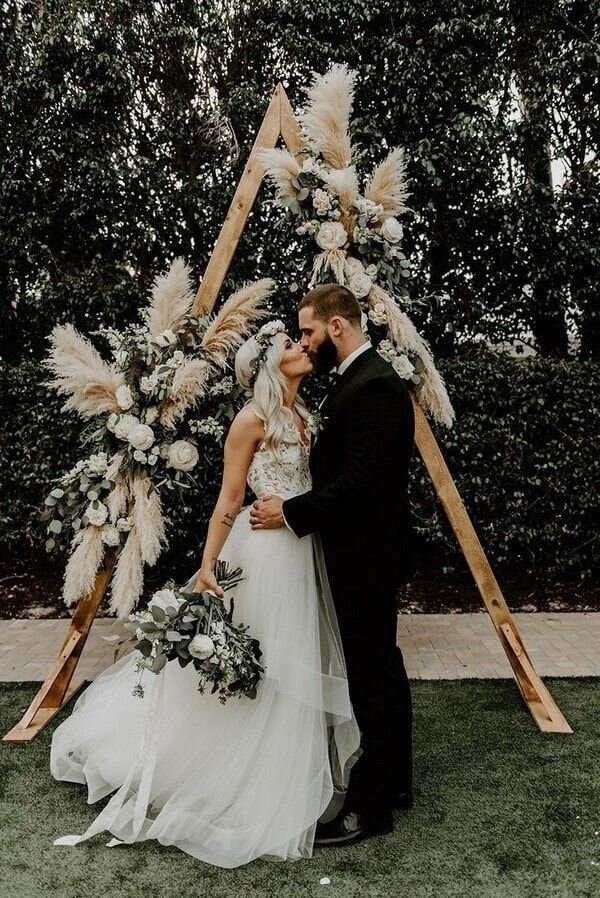
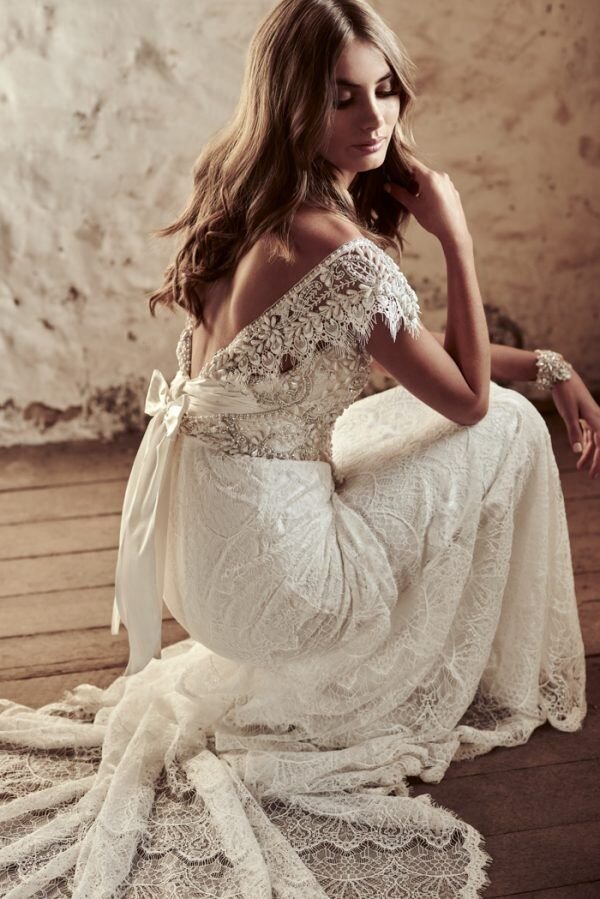
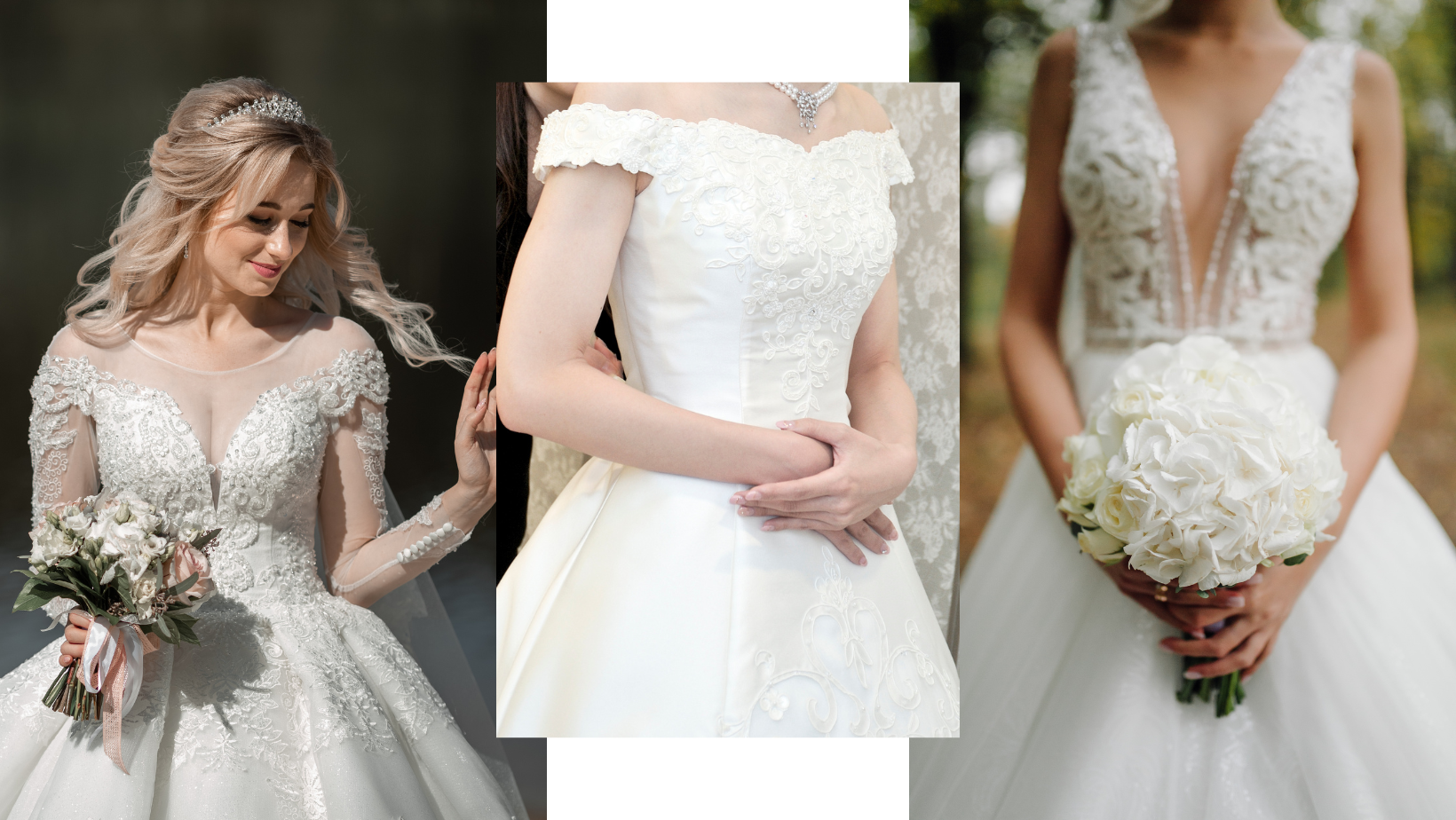
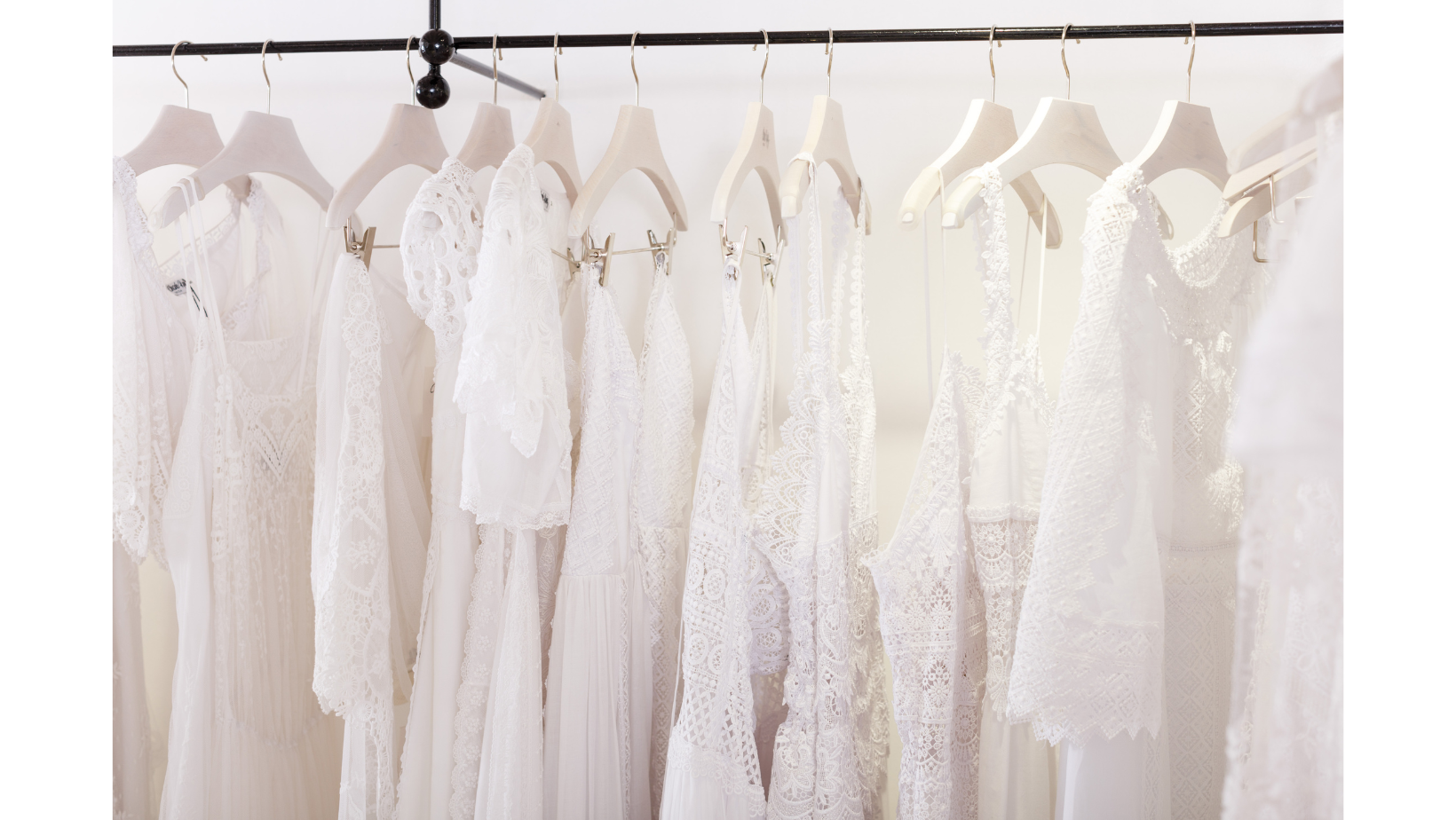
Step 2: Choose the fabric The fabric is everything in a wedding dress! It will be the first thing that gets noticed, but there are many fabrics available, depending on the type of effect you want to give your outfit, and this can complicate the choice. If you are a classic bride who wants a traditional wedding, tulle is your fabric. Are you organizing a country wedding? Then you could opt for a chiffon or lace dress. In general, keep the following in mind: · Tulle: it is the most voluminous and romantic fabric, ideal for giving volume and therefore designed for princess wedding dresses. It gives lightness and transparency, ideal for romantic brides; · Chiffon: a light and ethereal fabric, for a wedding dress with soft and flowing lines or with a lot of volume: a prime example is dresses for beach weddings; · Organza: it can be silk or cotton. It is a treated but very refined fabric both to the touch and to the eye, stiffer than chiffon and slightly transparent, its shades are pearly; · Taffeta: it is a type of very shiny silk, a fabric that gives a lot of volume to the dress, with a rigid and glossy structure; · Satin: soft, smooth and shiny fabric; · Lace: it is a fabric that is used alone or to embellish others. Lace wedding dresses are the expression of sensuality while, if heavily embroidered, it is suitable for a regal or vintage wedding dress; · Mikado: it is a type of shiny natural silk. Boundless elegance and majesty are enclosed in this Japanese fabric. · Crêpe: it is the ideal fabric for mermaid-cut wedding dresses. It can be wool, georgette, pleated: it is a fabric with an irregular appearance often embellished with embroidery and precious stones.
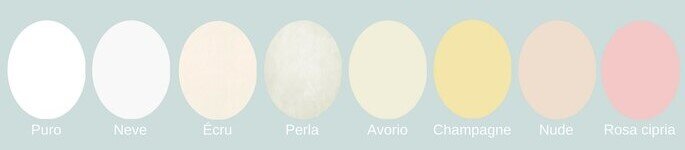
Step 3: Choose a color that suits your complexion The white wedding dress represents that tribute to tradition that even the most extravagant bride does not want to miss; although over the years its meaning of purity has faded, the custom has remained. Choosing the white dress is also a way to stand out from the rest of the guests, to be the only protagonist of the celebration. Haute couture houses have worked to offer a wide range of shades of white, with an eye to tradition but with a modern twist. There are therefore numerous shades to choose from and, above all, they should blend as best as possible with the tone of your skin: · Pure: a total and deep white with slight bluish hues. Ideal for brides with a dark complexion. · Snow: a radiant shade but not as “brilliant” as the previous one. Snow white is designed for brides with an amber complexion. · Ecru: also called “off-white.” It is the most used shade by brides for its versatility and for its less artificial nature. · Pearl: it is the perfect shade for a wedding dress for a civil wedding and for brides over 40. Very similar to the previous shade but with slight “vanilla” hues.
· Ivory: very close to beige, ivory is the shade designed for brides with a very fair complexion. · Champagne: slightly golden and designed for every type of skin and complexion. Spectacular in wedding dresses for brides with darker hair and complexion. · Nude: it is the color closest to that of the skin. For this reason, it is not used as the main color but only in accessories and details that enrich the outfit. · Blush pink: it is the most romantic color and the one that most departs from pure white. It is ideal for brides with fair skin and for those who love the vintage allure.
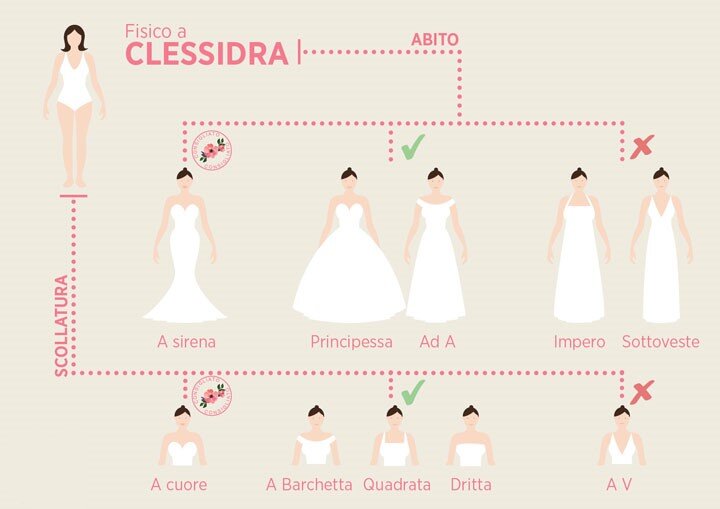
And what about the colored dress? It is ideal for expressing an extravagant side of your character or personal taste, to break the mold by showing a non-conventional and irreverent way of being. Recommended for themed weddings, especially for those that require a specific shade as a common thread, but choose a color that enhances your qualities and matches the ceremony. Step 4: Choose a dress that suits your silhouette Often, when looking for inspiration in magazines or online, you fall in love with dresses that are not suitable for your body type or you arrive at the atelier with a set idea of the dress you want. At this stage, however, it is right for you to be rational: consider your body shape, so you can look for dress models that enhance your figure, highlighting your strengths instead of amplifying small flaws, softening those features of your body you feel most insecure about. Don't choose a model just because it's the latest fashion, following current trends is fine, but they must be adapted to your body, don't insist on trying on unsuitable styles for your figure. For example, if you have wide hips, avoid a tight mermaid model, as it will only highlight them even more. How to choose a wedding dress to enhance your silhouette? Let's look together at the main body types: · Hourglass figure: if you are an hourglass woman you are very proportionate, because your shoulders are as wide as your hips and your waist is slim, just like the shape of an hourglass. Better than anyone, you can wear the mermaid dress if you like it, because it will enhance your perfect curves. If you also have a nice proportionate bust, the sweetheart neckline will make you irresistible. Dresses that are too loose-fitting, such as the empire style and slip dress, are not recommended, because it would be a shame not to highlight such a slim waist.
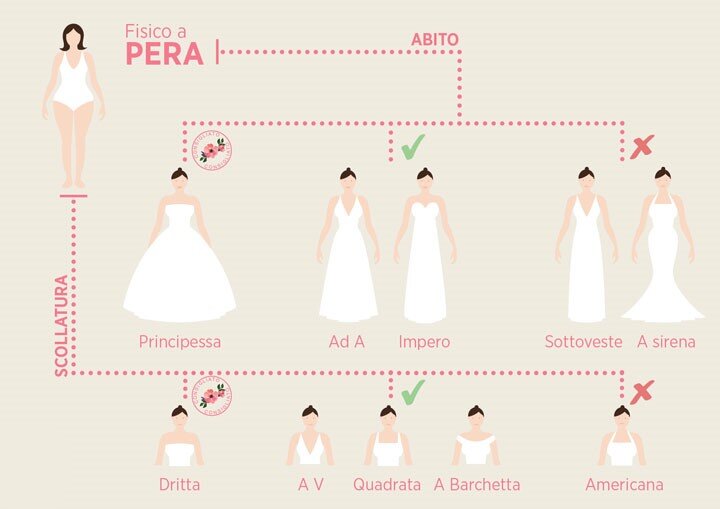
· Pear-shaped body: most Mediterranean women have a pear-shaped body, meaning the shoulders are a bit narrow, the bust is probably small, and the hips are (more or less) wide. As a result, it is best to choose a dress that highlights the upper part and does not emphasize the lower part too much. So yes to an empire or princess style dress, even with a beautiful, highly decorated bodice that would enrich the upper part of the body. The neckline should not further narrow your shoulders, so avoid the halter neckline, while a straight neckline will be perfect as it has the effect of widening, or a strapless neckline. Instead, avoid mermaid styles, too pronounced on the hips and lower back.
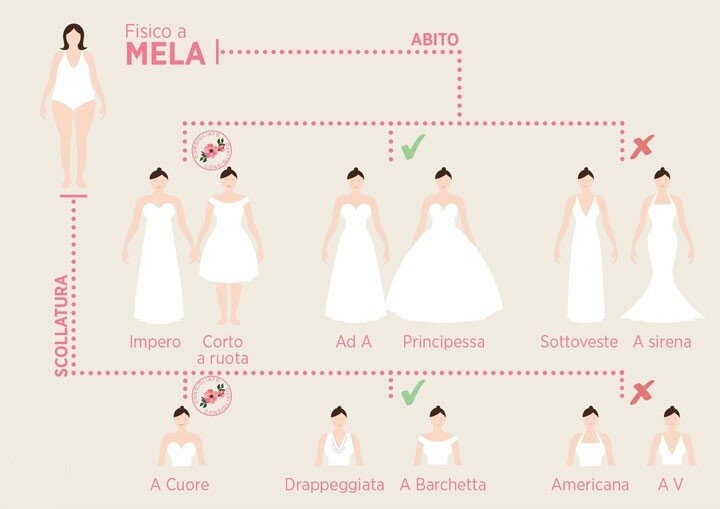
· Apple-shaped body: features greater width in the central part of the body and it is precisely from here that you should divert attention if you want to choose the right wedding dress for you: shift the focus to the areas that enhance you most, such as the bust and shoulders. Your ideal wedding dress should elongate your figure, and the style that best achieves this is the empire style. If you don't feel comfortable, you can go for a princess-style dress, which will fully embrace your curves, or a slip dress, perhaps with a sweetheart neckline, to enhance your décolleté. If you have beautiful legs and the style of your wedding is not at odds with such a choice, you could opt for a short flared dress!
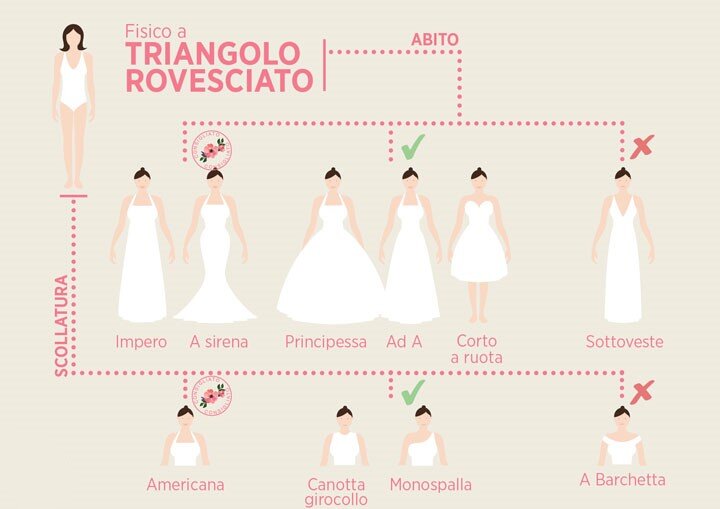
· Inverted triangle body shape: if you have very broad shoulders while your waist and hips are slim, the “mission” is to draw attention to the upper part of the dress and highlight the waistline with an empire style or mermaid dress, but be careful because if your hips are very narrow, the mermaid style could emphasize a “gap”; you could opt for A-line wedding dresses since they are fitted at the waist and then flare out. Not recommended instead is the slip dress which, being very loose and not defining the shape, would make you look as wide as your shoulders. The halter neckline is great as it makes the shoulders look a bit smaller, but avoid the boat neckline, which would make them look even wider.
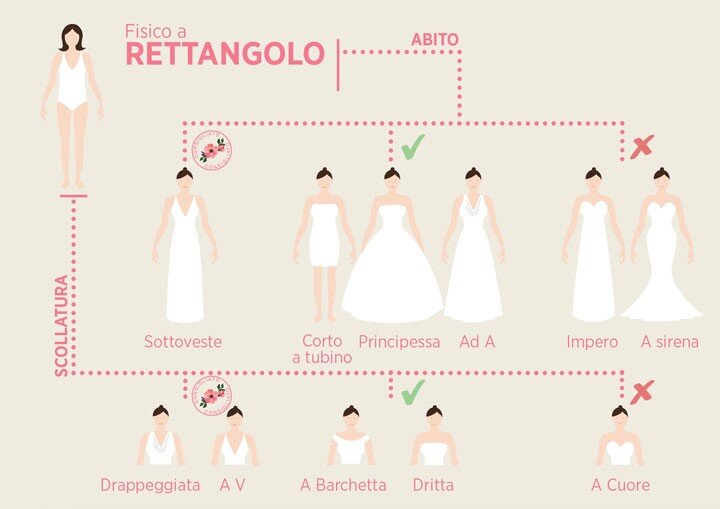
· Rectangle body shape: if you are a rectangle-shaped woman, it means that your shoulders, hips, and waist are more or less the same width, so curves are not really your main feature. Therefore, you need to avoid all those dresses that would emphasize the lack of roundness such as mermaid and empire style dresses, slip dresses, round and square necklines. You should favor dresses with V-necklines, slip dresses, strapless or off-shoulder styles. With your body type, you can dare with necklines, both in the front and on the back. · Curvy brides: the ideal would be an empire style wedding dress, cut below the waist, which opens up airy and light. Avoid dresses that are too tight, like mermaid styles. To enhance the neckline, it's better to choose a sweetheart neckline and avoid accessories and decorations that are too showy.
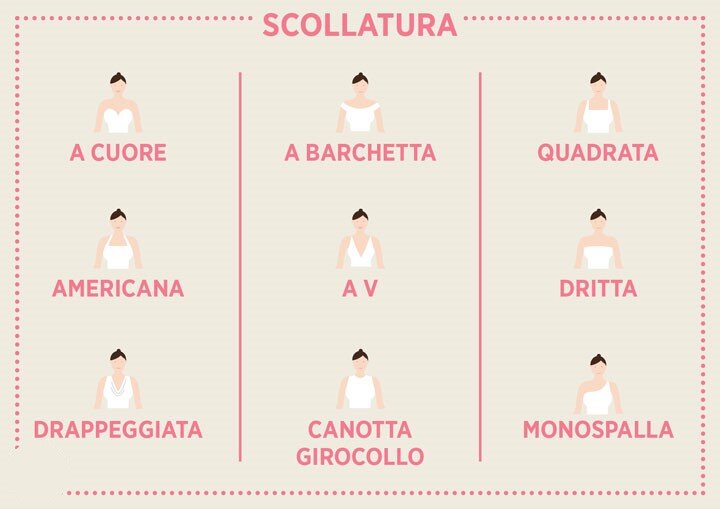
Even the necklines of the dresses can make a difference in the final effect. A useful secret on how to choose a wedding dress is in fact to start from the neckline; here are the types of necklines and who they suit: · square neckline: enhances the bust and slightly compresses it, for those who want to show off their shape in an elegant way; · off-shoulder neckline: both for those with a generous bust and for those with a smaller one; · V-neck: a less deep but wide V up to the shoulders for those with a large bust, a very deep V down to the stomach for those with a smaller bust; · sweetheart neckline: for curvier women, to elongate the figure and give a romantic effect; · boat neckline: for an elegant bride who is not too curvy; · halter neckline: for those who do not have a large bust and want to dare with a different neckline; · high neck: generally in lace, perfect for brides with a small bust who want to enhance the waistline thanks to a tight bodice; · round neckline: for petite brides with narrow shoulders but also for those with generous curves.
Last topic, decisive for choosing the wedding dress: long or short? The wedding dress is traditionally white, long, and with a train, and it's hard to move away from these customs that are very "wedding"; however, there are other types of cuts, such as the short one and the mid-length one. Besides personality, what should lead us to choose a long wedding dress? Still height! Not that a long dress can't be worn by a short woman, however, it's clear that a tall woman will be able to wear it with greater ease. A petite woman, on the other hand, can opt for a long dress with an A-line skirt, while the mermaid dress might be the least suitable. Short dresses, with a cut above the knee, are the option most often chosen by brides of older age or by those who do not wish to follow traditions to the letter. Even brides of short stature can easily choose this type of dress, which will elongate them, not to mention women whose strong point is precisely their legs. The main styles are: balloon, sheath, with a train attached only at the back.
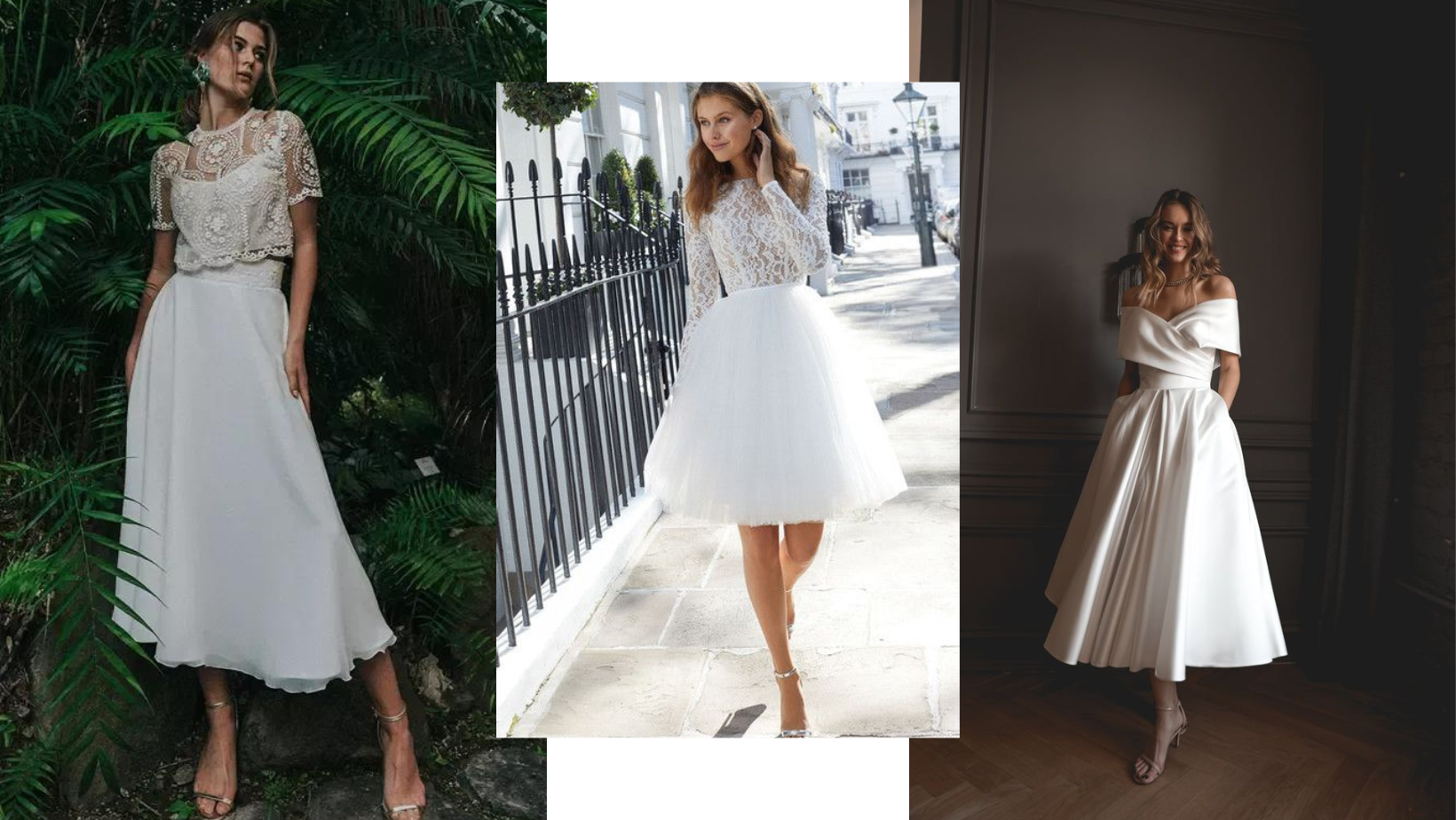
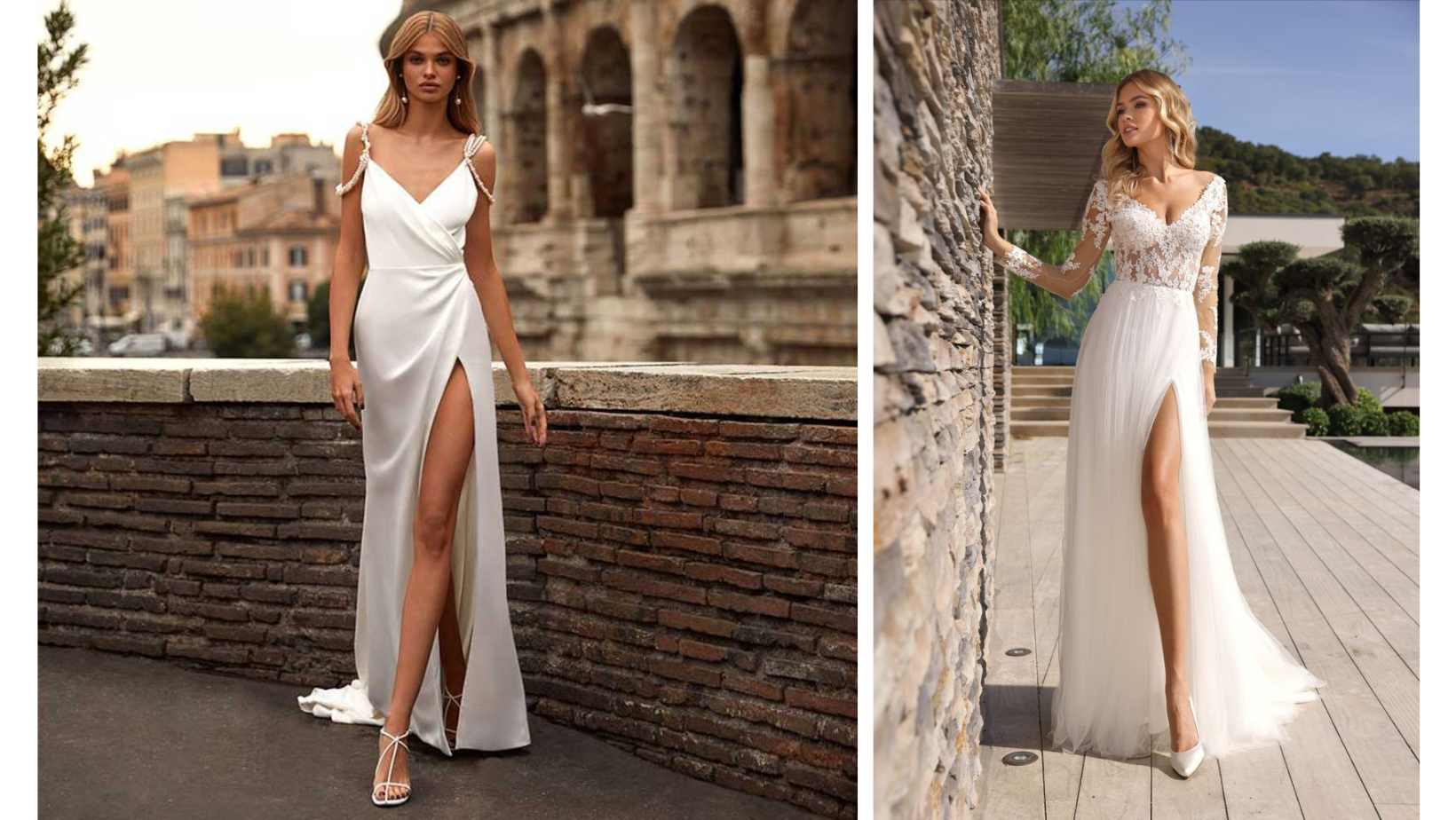
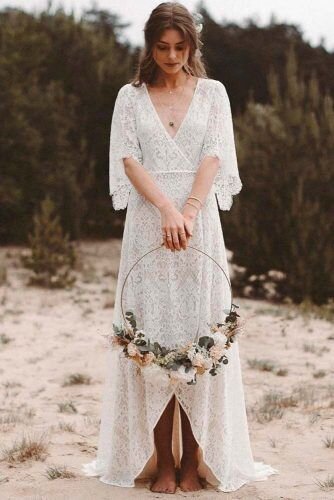
Short wedding dresses are also perfect as a change of outfit to wear during the reception: a comfortable solution, as well as a way to give an original touch to the wedding. The mid-length (or midi) wedding dress, a tribute to the '50s or '20s, is perhaps the least chosen but one of the most elegant and aims to enhance the figure: a slip dress, cut above the ankle and cinched at the waist, will elongate the bride, a fitted sheath dress, cut at mid-calf, will be perfect for a slender woman, while a balloon dress will be useful for hiding some imperfections on the hips. And what about wedding dresses with a slit? You can't deny it's a real trend as well as a trump card for elongating the figure. The slit, which can be on the side or at the front, also gives movement to the dress and that extra touch of sensuality that never hurts. The most popular are those on flowing skirts, in tulle or silk.
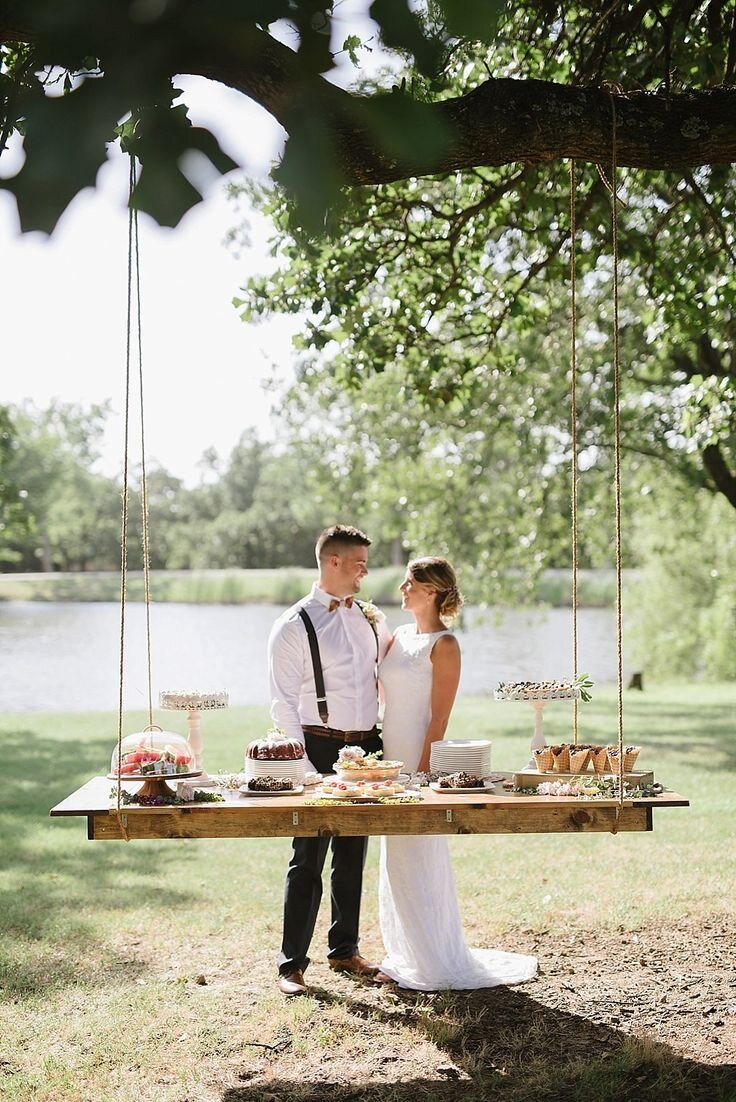
Step 5: Choose your wedding dress based on the style The style of the wedding dress goes hand in hand with that of the entire wedding, and each venue requires a certain type of wedding dress rather than another. The advice, in my opinion fundamental, is to imagine yourself in the overall context before starting your search, to avoid focusing on styles that are not suitable. The most classic example is choosing a dress with a long train if you are getting married in a small country church or on the beach. For these settings, you’ll need a more “easy”, light, comfortable, and low-maintenance dress. Meanwhile, a long train will be perfect for a wedding in a historic villa, with large luxurious spaces. Or in a large church with an impressive nave. The fundamental question is: does the dress reflect you in the chosen environment? If you have visualized in your mind the overall atmosphere you want to experience at your wedding, it will be much easier for you to select the ateliers to visit, first researching the designers who best interpret the style you desire. The last thing not to overlook is the temperature: if you are getting married in winter rather than in summer, the fabrics and lines must follow the season and the time of day when you will have the ceremony, to keep you comfortable and at ease in every situation.
Step 6: Does it excite you? Don't underestimate your feelings, the emotion you feel or don't feel when wearing the dress: not all brides burst into tears in front of the perfect dress! Listen to your heart, your instinct, and the first impressions you feel when you look at yourself in the mirror. Don't focus on small imperfections because a sample garment, not in your exact size, can't already be perfect on your body. It's right to give importance to the opinions of the people close to you, with whom you have decided to share the moment of choosing your dress, but you shouldn't let these opinions override your own instincts.
Step 7: The timing of choosing the wedding dress It is extremely important not to wait until right before the wedding date to choose your wedding dress, so you have time to select your gown and give the atelier’s seamstresses the opportunity to make any necessary alterations to make it perfect. The ideal period is from 9 to 7 months before. Step 8: Ask for expert help Last but not least is the contribution of experts, obviously those present in the atelier but also the opinions of great designers and stylists. Choose someone who is truly an expert in the field, someone who has studied and knows perfectly the needs of brides: a technical opinion, given by an external eye, can help you understand if you are heading in the right direction. Finally, the help of the people who will accompany you during the wedding dress fittings is fundamental: your mom, sisters, and closest friends. If you found this article helpful, let me know in the comments or share it with a friend who is looking for her perfect dress! In the next blog article, you’ll find lots of useful tips to make the most of your appointment at the atelier!



